


September 29, 2026
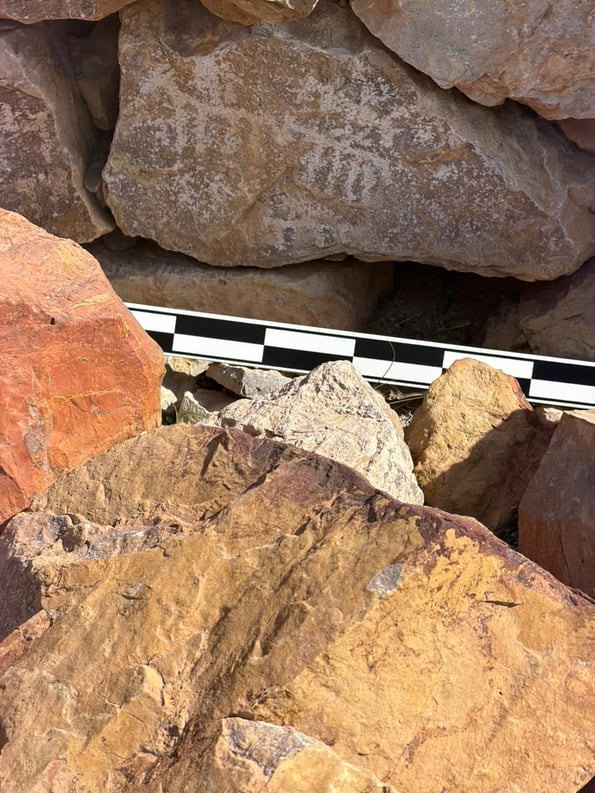
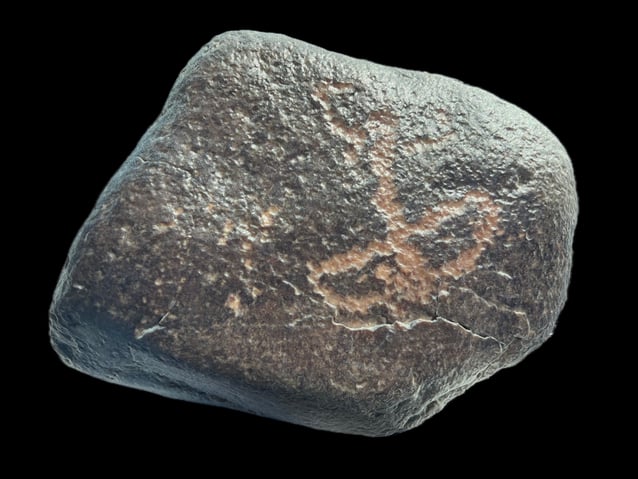
Ancient rock art petroglyphs discovered during archaeological surveys in Wadi Daftah, Ras Al Khaimah, offer valuable insights into past civilizations. Pecked into stone, these images depict human figures and their interactions with the surrounding environment. The realistic 3D-printed replica shown here was created from a light scan of an original boulder housed in the collection of the Department of Antiquities and Museums of Ras Al Khaimah. In it, one can see a schematic, anthropomorphic figure in motion, portrayed with raised arms and possibly holding a dagger in its right hand. The original rock was discovered on terraces above the wadi base, northeast of the modern village of Daftah, and has been part of the Ras Al Khaimah Museum collection for more than twenty years.
Working with collaborators at NYU Abu Dhabi, I have adapted this technology to preserve the images found on rocks. Through this work, we have developed three heritage conservation protocols for documenting and safeguarding archaeological materials.
Why Restoration, Repair, and Research
Digital 3D model files, also known as OBJ files, can be used to create exact replicas for scholarly research or exhibition-quality displays. Because these highly accurate 3D models serve as digital twins, conservators can monitor and assess wear and tear, plan and carry out targeted maintenance, and maintain detailed records for future restoration work. Before an artifact is moved – whether from the field to storage, within a museum, or in another archaeological context – a scanned OBJ file should be created. If damage occurs during transport or relocation, the OBJ file can then be used to reproduce an accurate digital twin of the artifact whenever needed.
Supporting Education through 3D Models
Archaeologists, epigraphers, art historians, and historians are not always able to travel to excavation sites, and high-resolution images, while valuable, are not always sufficient. A 3D digital twin provides an accurate, handheld replica that allows scholars to study carvings and inscriptions closely without needing to handle fragile originals. In the future, university students could study artifacts of their interest by downloading OBJ files and producing their own 3D prints.
Building Virtual Museums for the Future
Beyond research and education, OBJ files also support the creation of digital archives for Ras Al Khaimah’s archaeological heritage. Using CAD-based geometric reconstructions, the project preserves detailed digital replicas of petroglyphs scanned in the field, capturing each artifact’s form, texture, and precise measurements. These digital models can be integrated into interactive virtual and augmented reality experiences, expanding public access to Ras Al Khaimah's cultural heritage.
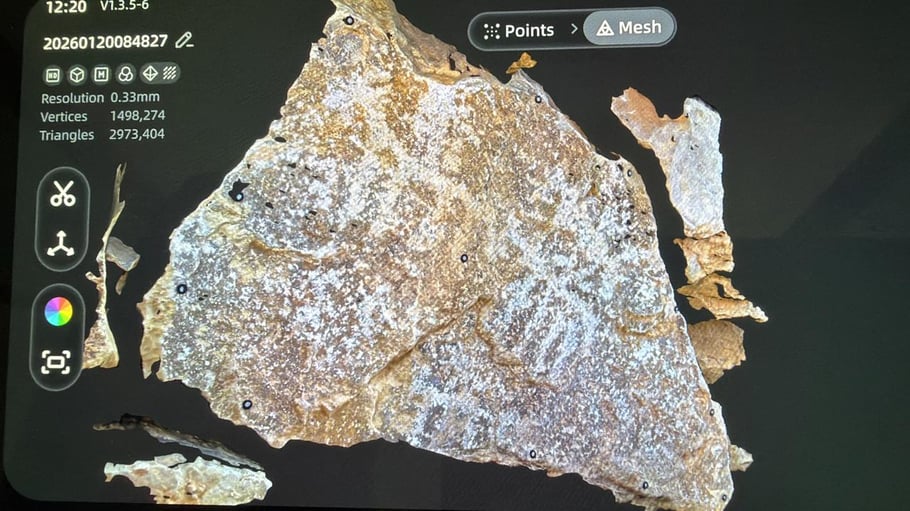
A field scan at a Julfar-period village in the RAK Mountains.