



October 8, 2026
Heritage is often imagined as something formally preserved and easy to identify: an old fort under restoration, the remains of an archaeological site, or a building protected by an official plaque. Yet many places hold their history in less visible ways – in the shape of a shoreline, the shelter of mangroves, routes followed out of habit, and the shared understanding that certain landscapes matter even when little of their past survives in built form.
Al Rams, in northern Ras Al Khaimah, is one such place. Long associated with coastal settlement and everyday reliance on surrounding wetlands, the area reflects a relationship between people and place that has developed over generations. Recent environmental studies show the importance of Ras Al Khaimah’s northern coastal ecosystems (Raihan, Ali and Mortula, 2024; Pandi Selvam et al., 2025). But landscapes can also preserve forms of continuity that formal heritage lists do not always capture. This raises an important question: How should we understand heritage when the past is carried not only by monuments, but also by familiarity, repeated use, and the lasting imprint of everyday life?
Beyond What We Can See
Mangroves are most often understood as environmental assets, valued for supporting biodiversity and protecting coastlines. But alongside their ecological importance, they can also hold cultural meaning that is less visible. Research conducted in collaboration with the Al Rams community highlights how these mangroves are experienced as lived landscapes, shaped by everyday practices, familiarity, and long-term engagement.
Participants in the project connected the mangroves with fishing routines, tidal rhythms, and songs once sung along the shoreline. Their accounts show how knowledge of Al Qurm, the mangroves, is carried through cultural practices as well as through observation.
“The songs come from the mangroves themselves, Al Qurm.”
– Community participant
Here, heritage is not separate from the landscape but embedded in how people use and understand it in daily life. It is expressed in knowing where to walk, how the tides shift, how fishing patterns change, and which environmental signs matter to those familiar with the area. These lived understandings of the mangroves are not always easily captured by formal approaches to heritage, which often focus on what can be physically identified, recorded, or preserved.
Recognizing Community Knowledge
When heritage is held in memory and everyday practice rather than in visible objects, recognizing it depends on listening to the people who know the landscape best. In Al Rams, community knowledge does more than add cultural meaning to the environmental value of the mangroves; it helps explain why these coastal spaces matter. Memories of fishing routes, inherited knowledge of Al Qurm, and oral traditions tied to the shoreline all form part of the site’s historical significance.
This suggests that when heritage documentation focuses primarily on what can be physically recorded or displayed, important parts of a place’s meaning can be overlooked. The mangroves, for example, can be mapped and described environmentally, while the lived experiences that give them cultural depth are harder to record. The result can be an account of the landscape that captures what is physically present without fully representing the knowledge and memories attached to it.
For cultural institutions and policymakers working across heritage and environmental conservation, community testimony can therefore offer an important source of understanding. Oral histories, collaborative documentation, and sustained engagement with residents can help ensure that heritage representation reflects not only the physical landscape, but also the relationships that have shaped it over time.
Mangroves, Memory, and the UAE’s Sustainable Future
These local insights also carry wider policy relevance as environmental sustainability gains increasing attention across the UAE. Mangrove restoration now sits at the centre of several national climate initiatives, including the UAE’s commitment to plant 100 million mangroves by 2030 as part of its Net Zero 2050 Strategy. But protecting mangroves is not only about their environmental function. The experiences shared in Al Rams show that these ecosystems can also carry social and cultural meaning shaped by long-standing community relationships.
This connection between environmental protection and cultural meaning comes through clearly in participant accounts. One participant compared the mangroves to a child – something to be nurtured and protected as it grows. The comparison shows how the prospect of climate-related damage is felt not only as an environmental concern, but also as a personal and cultural loss.
“The mangroves are like a child. You care for them, you want to see them grow. I would be very upset if climate change impacted the mangroves.”
– Community participant
Recognizing mangroves as cultural landscapes as well as natural resources allows for a more complete approach to conservation. It moves heritage practice beyond documenting what is physically present toward understanding how places are valued, remembered, and cared for by the communities around them. In Al Rams, the mangroves are more than part of the coastline; they are part of the community’s historical memory. Protecting them therefore means preserving both a natural ecosystem and a lived cultural inheritance.
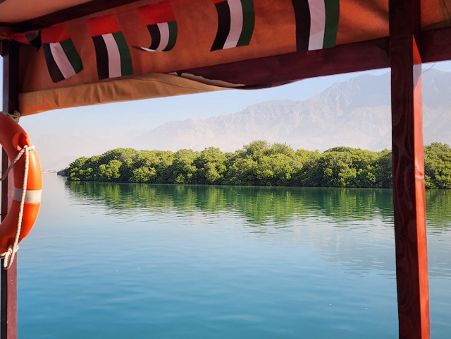
Mangrove in Ras Al Khaimah. Photo by the author
References
-
Pandi Selvam, P., Mohan, M., Dutta Roy, A., Ali, T., Watt, M.S. and Samara, F. (2025) ‘Advancing oyster habitat mapping: Integrating satellite remote sensing to assess coastal development impacts in northern United Arab Emirates’, Marine Pollution Bulletin, 215, 117861. https://doi.org/10.1016/j.marpolbul.2025.117861
-
Raihan, A., Ali, T. and Mortula, M. (2024) ‘Unveiling coastal ecosystem dependencies: multifactorial analysis of climate change influencing mangrove system in the United Arab Emirates over the period 1990–2020’, Discover Sustainability, 5, 498. https://doi.org/10.1007/s43621-024-00620-9